
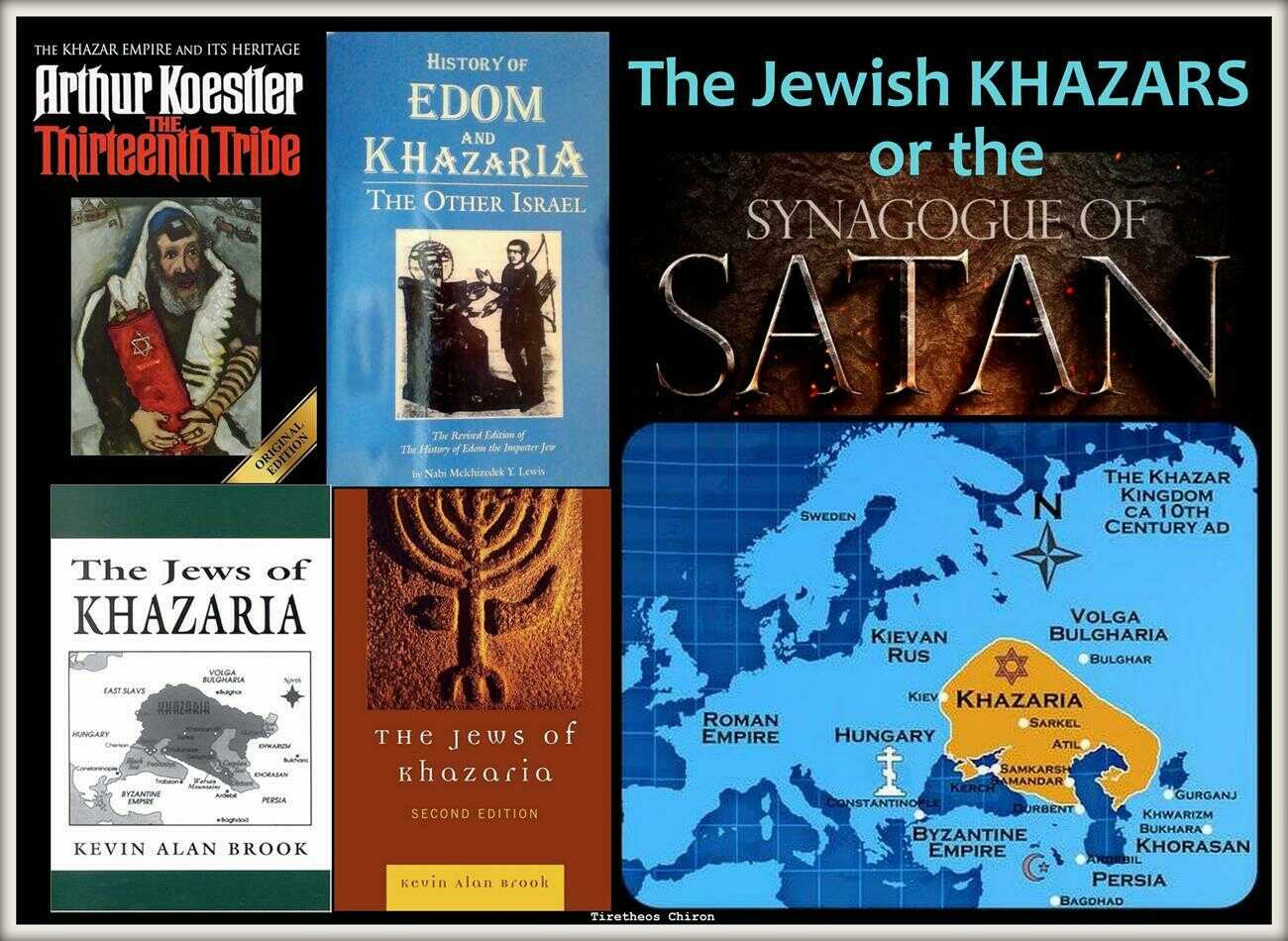
> A partial list of literature on Jewish Khazars: 👹✡️
1. The Ashkenazic Jews: A Slavo-Turkic People in Search of a Jewish Identity by Paul Wexler
2. The Jews of Khazaria by Kevin Alan Brook.
3. The Invention of the Jewish People by Shlomo Sand.
4. The Kuzari and the Shaping of Jewish Identity, 1167–1900 by Adam Shear
5. The Thirteenth Tribe by Arthur Koestler.
6. Facts are facts by Benjamin H. Freedman
7. A Social & Religious History of the Jews by Salo W. Baron
8. History of the Jews by Prof H. Graetz
9. The Invention of the Land of Israel: From Holy Land to Homeland by Shlomo Sand
10. The History of Jewish Khazars by D. M. Dunlop
11. The World of the Khazars by Peter B. Golden, Haggari Ben-Shammai & Andrais Rona-Tas
12. The Origin of Ashkenazi Jewry: The Controversy Unraveled – Jits van Straten – East European Jews are mainly descendants of Ukrainians and Belarussians.
13. Robert G. Hoyland, In God’s Path: The Arab Conquest and the Creation of an Islamic Empire (New York: Oxford University, 2015)
14; Susan Wise Bauer, The History of the Medieval World: From the Conversion of Constantine to the First Crusade (New York: W. W. Norton, 2010), 363-364. Bauer seems to admit this reluctantly.
15. Charles King,The Black Sea: A History (New York: Oxford University Press, 2005), 74-75
16. Khazaria by Prof. Abram. N. Poliak, Professor of Medieval Jewish History at Tel Aviv University, published his book KHAZARIA in 1944, says:
“The descendants of this settlement (Khazars in Eastern Europe)—those who stayed there and those who emigrated to the United States, or went to Israel—constitute the largest majority of world Jewry.”
17.THE WORLD OF THE KHAZARS is a selection of papers from the Jersualem 1999 International Khazar Colloquium edited by Peter B. Golden, Haggai Ben-Shammai and Andras Rona-Tas. Many of the papers were subsequently updated and expanded and the volume was finally published by Brill in 2007 as part of their Handbook of Oriental Studies series.
As an Indo-European – Uralic – Turkic linguist, my main interest when it comes to the Khazars is their language, which is understood to be a member of the Turkic family but whose exact classification is elusive. Marcel Erdal’s “The Khazar Language” is a fine introduction to the debate. Erdal abundantly cites earlier discussions and then explains how none of the criteria used to prove that a language is Chuvash-type Turkic have proven conclusive. Andras Rona-Tas’ “The Khazars and the Magyars” helps us understand this aspect of early Turkic-Uralic contacts, though it is more a rough extract of his book HUNGARIANS AND EUROPE IN THE EARLY MIDDLE-AGES than a satisfying standalone paper.
Some of the papers are on general history and relations with other states. From Irina A. Arzhantseva we have “The Alans: Neighbours of the Khazars in the Caucasus”. Thomas S. Noonan contributes “The Economy of the Khazar Khagante”. James Howard-Johnson writes on Byzantine sources for Khazar history. Tatiaana Kalinina, David Wasserstein and Dan Shapira write on interactions between the Khazars and the Muslim world, while Vladimir Petrukhin examines Khazaria-Rus’ relations.
The remaining papers deal with the Khazars’ famous conversion to Judaism. Peter B. Golden’s contribution is a discussion of their adoption of the religion. Artem Fedorchuk offers “New Findings Relating to Hebrew Epigrahic Sources from the Crimea”. Victor Shnirelman contributes “The Story of A Euphemism”, a look at how Russian nationalists have viewed the Khazars as the first conspiracy against their country, and whose shadowy heirs continue to cause trouble. Paul Wexler offers “Yiddish Evidence for the Khazar Component in the Ashkenazic Ethnogenesis”.
Lothrop Stoddard, the leading racial theorist of the interwar period, described two races of Jews in his 1926 article in the Forum titled “The Pedigree of Judah. The “aristocratic” Sephardic Jews, who had entered the Mediterranean world […]. However, the Ashkenazic Jews were a mixture of diverse bloods, whose features reflected intermarriage with the Hittites. These eastern Jews had migrated into southern Russia, where they then blended with the Khazars, whom Stoddard regarded as a combination of Turkish and Mongoloid peoples.
By the 1960s, the Khazar ancestry of the Jews was a firm article of faith. Two books, widely read in this milieu, came to exercise a strong influence in this regard. John Beaty’s Iron Curtain over America (1951) focused especially on the roots of Russian Jewry. He claimed that the reforms of Czar Alexander II gave the “Judaized Khazars,” who had converted in the seventh century, the opportunity to infiltrate and corrupt Russia. Wilmot Robertson’s Dispossessed Majority (1972) repeated the Khazar thesis of Stoddard. Christian Identity teachings readily seized on this negative reference to Russian Jewry, but backdated Jewish intermarriage with the Khazars into biblical times. […]
The novel ‘When?’ describes an apocalyptic military climax to the Second World War set in Palestine. After the British retreat from Jerusalem, the city is captured by the evil forces of Gog, aided by Zionists—none other than inauthentic Jews who are the descendants of ancient intermarriages with impure races. […]
In 1948, the year of the creation of the state of Israel, C. F. Parker repeated the view that there were two races of Jews. He considered the Zionists to be almost exclusively Ashkenazim […] If the Sephardim were pious and apolitical, the Ashkenazic Zionists shamelessly mobilized the financial and political influence of European and American Jewry to support their campaign for a sovereign state. “The newly declared Jewish State of ‘Israel’ is as ersatz and barren as its predecessor, the Herodian-Jewish nation, for it still rejects Jesus Christ. . . . The Jews have seized the Holy Land from the rightful owners […].”12
Howard Rand also fulminated against the new state, branding it the work of “renegade Jews,” not “true Israelitish Jews.” He described these “renegades” as the same impostors who had led the Russian Revolution thirty years earlier. In a later article, he identified the Zionists with “a Great Conspiracy” and “programme of evil,” whereby the Jews had deceived Christians, so that Jews appeared to be the rightful heirs to the state of Israel. This grand deception, he argued, had extensive ramifications among the Nihilists, the Illuminati, the Fabians and the House of Rothschild.
#gazaunderattack #endoppression #israelicrimes #jewbook #tiretheonism #freepalestine #israelkillingchildren
#ceasefirenow #stopgazagenocide #talmudsaidso #welcometothejwo
> A partial list of literature on Jewish Khazars: 👹✡️
1. The Ashkenazic Jews: A Slavo-Turkic People in Search of a Jewish Identity by Paul Wexler
2. The Jews of Khazaria by Kevin Alan Brook.
3. The Invention of the Jewish People by Shlomo Sand.
4. The Kuzari and the Shaping of Jewish Identity, 1167–1900 by Adam Shear
5. The Thirteenth Tribe by Arthur Koestler.
6. Facts are facts by Benjamin H. Freedman
7. A Social & Religious History of the Jews by Salo W. Baron
8. History of the Jews by Prof H. Graetz
9. The Invention of the Land of Israel: From Holy Land to Homeland by Shlomo Sand
10. The History of Jewish Khazars by D. M. Dunlop
11. The World of the Khazars by Peter B. Golden, Haggari Ben-Shammai & Andrais Rona-Tas
12. The Origin of Ashkenazi Jewry: The Controversy Unraveled – Jits van Straten – East European Jews are mainly descendants of Ukrainians and Belarussians.
13. Robert G. Hoyland, In God’s Path: The Arab Conquest and the Creation of an Islamic Empire (New York: Oxford University, 2015)
14; Susan Wise Bauer, The History of the Medieval World: From the Conversion of Constantine to the First Crusade (New York: W. W. Norton, 2010), 363-364. Bauer seems to admit this reluctantly.
15. Charles King,The Black Sea: A History (New York: Oxford University Press, 2005), 74-75
16. Khazaria by Prof. Abram. N. Poliak, Professor of Medieval Jewish History at Tel Aviv University, published his book KHAZARIA in 1944, says:
“The descendants of this settlement (Khazars in Eastern Europe)—those who stayed there and those who emigrated to the United States, or went to Israel—constitute the largest majority of world Jewry.”
17.THE WORLD OF THE KHAZARS is a selection of papers from the Jersualem 1999 International Khazar Colloquium edited by Peter B. Golden, Haggai Ben-Shammai and Andras Rona-Tas. Many of the papers were subsequently updated and expanded and the volume was finally published by Brill in 2007 as part of their Handbook of Oriental Studies series.
As an Indo-European – Uralic – Turkic linguist, my main interest when it comes to the Khazars is their language, which is understood to be a member of the Turkic family but whose exact classification is elusive. Marcel Erdal’s “The Khazar Language” is a fine introduction to the debate. Erdal abundantly cites earlier discussions and then explains how none of the criteria used to prove that a language is Chuvash-type Turkic have proven conclusive. Andras Rona-Tas’ “The Khazars and the Magyars” helps us understand this aspect of early Turkic-Uralic contacts, though it is more a rough extract of his book HUNGARIANS AND EUROPE IN THE EARLY MIDDLE-AGES than a satisfying standalone paper.
Some of the papers are on general history and relations with other states. From Irina A. Arzhantseva we have “The Alans: Neighbours of the Khazars in the Caucasus”. Thomas S. Noonan contributes “The Economy of the Khazar Khagante”. James Howard-Johnson writes on Byzantine sources for Khazar history. Tatiaana Kalinina, David Wasserstein and Dan Shapira write on interactions between the Khazars and the Muslim world, while Vladimir Petrukhin examines Khazaria-Rus’ relations.
The remaining papers deal with the Khazars’ famous conversion to Judaism. Peter B. Golden’s contribution is a discussion of their adoption of the religion. Artem Fedorchuk offers “New Findings Relating to Hebrew Epigrahic Sources from the Crimea”. Victor Shnirelman contributes “The Story of A Euphemism”, a look at how Russian nationalists have viewed the Khazars as the first conspiracy against their country, and whose shadowy heirs continue to cause trouble. Paul Wexler offers “Yiddish Evidence for the Khazar Component in the Ashkenazic Ethnogenesis”.
Lothrop Stoddard, the leading racial theorist of the interwar period, described two races of Jews in his 1926 article in the Forum titled “The Pedigree of Judah. The “aristocratic” Sephardic Jews, who had entered the Mediterranean world […]. However, the Ashkenazic Jews were a mixture of diverse bloods, whose features reflected intermarriage with the Hittites. These eastern Jews had migrated into southern Russia, where they then blended with the Khazars, whom Stoddard regarded as a combination of Turkish and Mongoloid peoples.
By the 1960s, the Khazar ancestry of the Jews was a firm article of faith. Two books, widely read in this milieu, came to exercise a strong influence in this regard. John Beaty’s Iron Curtain over America (1951) focused especially on the roots of Russian Jewry. He claimed that the reforms of Czar Alexander II gave the “Judaized Khazars,” who had converted in the seventh century, the opportunity to infiltrate and corrupt Russia. Wilmot Robertson’s Dispossessed Majority (1972) repeated the Khazar thesis of Stoddard. Christian Identity teachings readily seized on this negative reference to Russian Jewry, but backdated Jewish intermarriage with the Khazars into biblical times. […]
The novel ‘When?’ describes an apocalyptic military climax to the Second World War set in Palestine. After the British retreat from Jerusalem, the city is captured by the evil forces of Gog, aided by Zionists—none other than inauthentic Jews who are the descendants of ancient intermarriages with impure races. […]
In 1948, the year of the creation of the state of Israel, C. F. Parker repeated the view that there were two races of Jews. He considered the Zionists to be almost exclusively Ashkenazim […] If the Sephardim were pious and apolitical, the Ashkenazic Zionists shamelessly mobilized the financial and political influence of European and American Jewry to support their campaign for a sovereign state. “The newly declared Jewish State of ‘Israel’ is as ersatz and barren as its predecessor, the Herodian-Jewish nation, for it still rejects Jesus Christ. . . . The Jews have seized the Holy Land from the rightful owners […].”12
Howard Rand also fulminated against the new state, branding it the work of “renegade Jews,” not “true Israelitish Jews.” He described these “renegades” as the same impostors who had led the Russian Revolution thirty years earlier. In a later article, he identified the Zionists with “a Great Conspiracy” and “programme of evil,” whereby the Jews had deceived Christians, so that Jews appeared to be the rightful heirs to the state of Israel. This grand deception, he argued, had extensive ramifications among the Nihilists, the Illuminati, the Fabians and the House of Rothschild.
 1
1
Comment
Share
Send as a message
Share on my page
Share in the group